
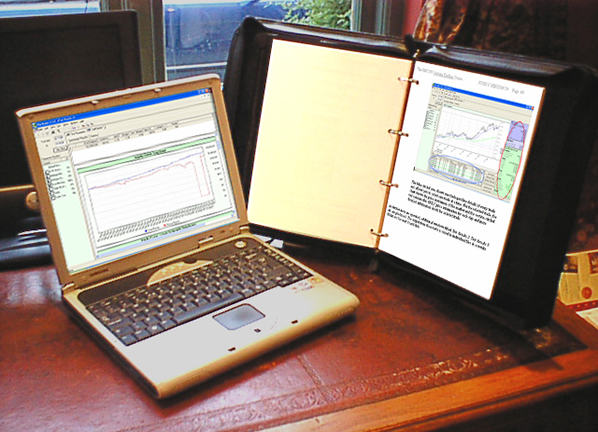
They look innocent enough, but this trio -
are levelling the playing field for the individual trader.
What does it take to be a successful commodities trader?
Quite a few years ago I asked myself that question. Since then I have spent thousands of hours, travelled thousands of miles and forked out thousands of dollars to find the answer.
The result of my efforts and
'market wizard'
knowledge
from some of
the world's most
successful
traders are in the
MODUS Commodity Trading Course.
SYSTEM TRADING - THE TIDE IS TURNING
With the advent of high quality testing software and the transfer of expert knowledge, prospects for success have increased sharply in favour of the individual trader wishing to trade his own capital.
System trading just means trading systematically. That implies a system, or set of rules that is applied consistently.
The value of trading this way was recognised a long time ago. Jesse Livermore said, "have a system and stick to it".
Commodity trading responds to this principle by delivering high rewards to whoever takes that advice.
There are good reasons for sticking to your system and there are also very good reasons why it appears to be so difficult for a trader to do.
Firstly, you need to recognise the differences between commodity futures and stocks. Commodities do trend, often moving purposefully as they come under the influence of political and economic factors. It is possible to benefit from systems that 'detect' and follow these trends.
Stocks are a different kettle of fish. At the individual stock level, markets are small and are more influenced by whims and fancies of investors than other factors. Taken together, they tend to be a random bunch and quite different to commodity markets.
The trend following principles that can be applied successfully to commodity futures markets do not usually work with other instruments.
So, getting back to Jesse Livermore. Having a system and sticking to it is very relevant to the trending nature of commodity futures and any trader who can accomplish this feat will be handsomely rewarded.
But why should it be so difficult to follow your own system? Surely there is nobody there to prevent you doing so?
Oh yes there is! It is YOU. You are the one who is the problem.
But to be fair, we should be more generous in apportioning the blame for your not following your system.
In Jesse Livermore's time, you had to manage your system without much help from machines, to do the numerous calculations necessary to test how a system would be likely to perform. Anything approaching thorough testing or scientific money management was out of the question.
So, when developing your system, estimation and 'judgement' played a big part in deciding the rules to be applied. It was not possible to cover all possible eventualities and so the 'less usual' situations would be dealt with by discretionary decisions when they arose.
Of course, as soon as discretion enters the scene, all hope of consistent action over time becomes extremely remote. Any experienced trader will tell you that unusual market situations are ten a penny and the chances that you could deal with these dispassionately as they came at you, would be nil.
Human emotions and 'good ideas' would destroy any prospect of consistent performance from the system. Hope and good luck would be all that remained to deliver success.
The truth is that the 'great traders' who traded under these conditions depended on good luck as much as skill.
Before computers came on the scene, it was not possible, in practice to operate a complete system, covering all eventualities and with any degree of consistency.
Furthermore, it was not possible to back-test a system, using scientific methods of position sizing - which is critically important to successful trading.
When Ed Seykota began his research, using a punched card main frame computer, he was among the first to prove that money could be made in trending markets by applying consistent methods. Even then, his bosses could not resist ruining everything by superimposing their own discretionary actions.
Undaunted, along with others, Ed went on to pioneer the birth of systems trading.
Although he was brought up in a different era, Richard Dennis realised that trading could be taught and that the routine running of systems would be best delegated to emotion-free computers if consistency was to be achieved.
Only consistency can hope to deliver the 'expected results' intimated by back-testing (back-testing is itself dependent on computers) and give the trader confidence to continue to follow his system.
When Dennis's Original Turtles showed what they could achieve, systems trading had made its point and was confirmed as the only scientific way to trade commodities successfully.
Although systems trading was the way to big profits in futures trading, it was not good news for everybody.
Systems trading has to encompass the whole of the trading process, including position sizing and price slippage control - in both the live and testing environments.
Computers with purpose designed sophisticated programs were required for systems trading and these could only be afforded by the few. Those who could afford it could have the muskets while the individual trader was left with the bow and arrow.
This situation has prevailed more or less unaltered until the present time and the minority of well resourced traders has regularly taken enormous profits from the commodities markets while individual traders have continually lost, almost without exception.
It does not have to remain that way because the cost of computing has fallen greatly, while the size of a powerful machine has shrunk to the size of a writing pad.
Realising what was needed, Curtis Faith, the most successful of the Original Turtles, wrote a comprehensive testing/trading harness, which he called VeriTrader.
VeriTrader was released last year and is clearly superior to anything else available today.
Of course, VeriTrader has been designed to carry out a thorough testing procedure and even allows multiple system operation.
The prospects for the individual trader have improved immensely with this software release but being 'behind the game' for so many years, the individual trader has not acquired the depth of knowledge and experience of systems trading that is necessary for confidence and success. This gap must be filled before he can get on equal terms with the professional trader.
This is why I have produced the MODUS Commodity Trading Course, which covers in six steps, the whole systems trading process.
The MODUS Course is fully integrated with VeriTrader and is a practical self-study programme which actively involves the student all the way through.
The MODUS Course is intended for beginners or those who wish to rapidly assimilate the 'musts' applicable for successful system trading.
The course can be taken at a leisurely pace, which is what I would recommend, or at full speed. I would estimate that most students will complete it in from 3 to 5 weeks, without exerting themselves too much.
There is no difficult maths and the material can easily be assimilated by anyone of average numeracy.
The course emphasises the importance of the trader having a system which is tailored to his requirements for risk, return and 'comfort'.
The problems of overtrading are clearly brought out and at the end of the course, the student will not only know that he must be comfortable with his system but will understand why.
The intention is that students should enjoy this course as well as profit from it and I can think of no wiser way for a student to spend his first 'trading dollars'.
Click here for more information about the MODUS Commodity Trading Course
